Tips
Why 95% of AI Agents Never Reach Production (And How to Fix It)
Most AI agents die in the pilot phase. Here's what actually breaks them — and the architecture decisions that get the other 5% to production.
AIKoders··5 min read
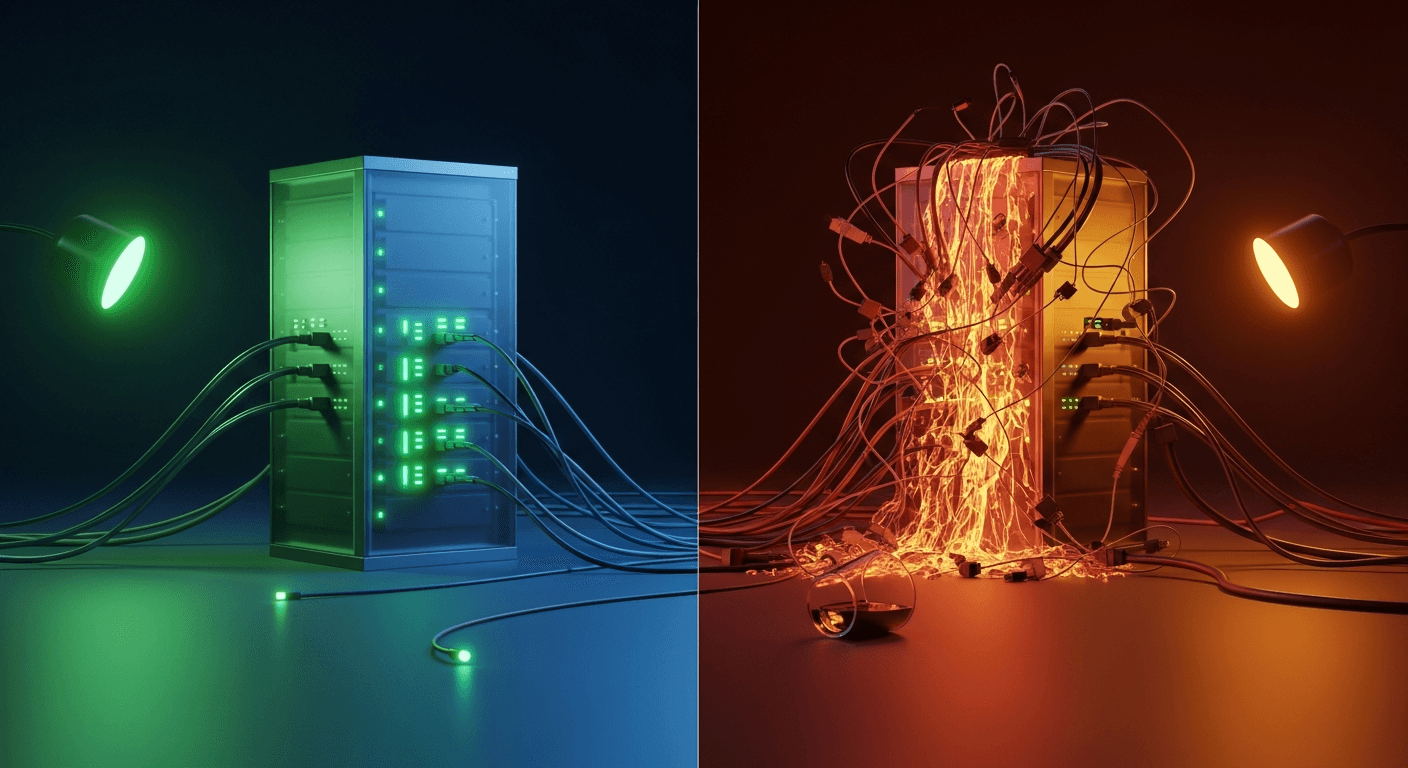
Why 95% of AI Agents Never Reach Production (And How to Fix It)
A 2026 MIT and Composio study found that 88 to 95% of AI agent pilots never make it to production. Gartner predicts 40% of agentic AI projects will be canceled by 2027. The gap between an impressive demo and a system that runs at 3 AM is wider than ever — and most teams don't see it coming.
This isn't a model problem. The frontier models keep getting better. The problem is what surrounds the model: the architecture, the guardrails, the integrations, and the engineering discipline that turns a Tuesday demo into a Monday morning production system.
Here's what actually breaks AI agents in production — and how the other 5% get built.
The Demo-to-Production Gap Is an Architecture Gap
The dominant narrative in AI engineering has shifted. As The New Stack put it recently: "The most consequential factor that determines whether an agent succeeds isn't the model powering it, but the architecture built around it."
A demo agent runs in ideal conditions. One user. Clean inputs. Predictable questions. No load. No edge cases. No real consequences when it fails.
A production agent has to handle messy reality:
- Concurrent users sending conflicting requests
- Malformed inputs, partial data, and timeouts
- Third-party API outages and rate limits
- Schema changes in upstream systems
- Edge cases the prompt was never tested against
- Real money, real customers, and real legal exposure when things break
The model is 10% of the work. The architecture around it is the other 90%. Teams that flip this ratio are the ones whose agents die in pilot.
The Five Failure Points That Kill Most Agents
1. No Evals, No Way to Know if Quality Is Drifting
Most teams ship an agent based on vibes — "it answered my five test questions correctly, ship it." Then a model update, a prompt tweak, or a tool change silently breaks 30% of responses, and nobody notices for weeks.
The fix: An eval suite that runs in CI. Every prompt change, every model swap, every tool update gets scored against a frozen test set. If quality drops below threshold, the build fails. This is non-negotiable for production.
2. No Observability Means No Debugging
When an agent gives a bad answer in production, the team needs to reconstruct exactly what happened: which tools were called, what context was retrieved, what the model saw, what it returned. Without traces, you're guessing.
The fix: Structured logging at every step of the agent loop. Trace IDs. Token counts. Latency per tool call. Privacy-safe payload logging. If you can't replay a failure, you can't fix it.
3. Hallucinations Without Guardrails
An agent that confidently invents a refund policy, a price, or a customer record is a legal and financial liability. "Just prompt it better" is not a guardrail.
The fix: Citation-backed retrieval. Schema validation on tool outputs. Refusal patterns when confidence is low. Human-in-the-loop for high-stakes actions. The World Economic Forum reported in January 2026 that 60% of CEOs slowed agent deployment specifically because of governance and error-rate concerns.
4. Insecure Integrations
88% of organizations running agents reported at least one security incident in 2025. The most common pattern: an agent given broad OAuth scopes, a shared API token across environments, or write access to a production database it should only read from.
The fix: Least-privilege scopes by default. Separate credentials per environment. Key rotation. Read-only access unless write is explicitly required. No shared tokens. Ever.
5. No Plan for Schema Drift
A real example from May 2026: teams upgrading n8n from v2.4.7 to v2.6.3 found their Vector Store tools generating invalid JSON schemas, breaking every OpenAI and Anthropic API call. No deprecation warning. No migration guide. Just silent breakage in production.
The fix: Pin versions. Test upgrades in staging. Monitor schema validation errors as a first-class signal. Assume every upstream system will change something breaking, and build accordingly.
What the 5% Do Differently
The teams whose agents survive contact with production share a few habits:
- Tight scopes from day one. They define exactly what the agent does, what it doesn't do, and what success looks like — measured in numbers, not adjectives.
- Production hardening is in the original plan. Evals, observability, guardrails, and security aren't "phase 2." They're built alongside the prototype.
- Multi-vendor freedom. 47% of developers report concern about LLM vendor lock-in. Production teams stay portable across OpenAI, Anthropic, Gemini, DeepSeek, and others — so a price hike or outage doesn't kill the system.
- Human-in-the-loop where it matters. The agent handles the 80% of cases that are routine. A human reviews the 20% that are high-stakes, ambiguous, or low-confidence.
- Telemetry-driven iteration. They watch what users actually do, where the agent fails, what costs are running, and they ship improvements weekly — not quarterly.
The MCP Shift Changes the Math
One reason 2026 is different from 2024: Model Context Protocol is now the de facto integration standard. 78% of enterprise AI teams have at least one MCP-backed agent in production. 67% of CTOs named MCP their default agent-integration standard. Over 97 million SDK downloads.
This matters because integration is where most agents used to die. Custom one-off connectors broke constantly. MCP gives agents a standardized way to talk to tools, databases, and services — which means less custom glue code and fewer integration failures. Teams building MCP-native today are skipping a category of failures that killed agents two years ago.
The Real Cost of a Failed Pilot
An AI pilot that dies in phase 2 isn't free. It costs:
- 3 to 6 months of engineering time
- Internal credibility for whoever championed it
- Confidence that AI can work at all in the company
- The opportunity to be 18 months ahead of competitors who succeeded
The companies that win in 2026 aren't the ones running the most pilots. They're the ones whose pilots actually become production systems.
Build for the 5%
Production AI isn't a feature you bolt on at the end. It's the architecture you start with on day one — tight scopes, evals in CI, observability built in, security by default, and an honest plan for everything that can go wrong at 3 AM.
If your team is staring at a stalled pilot, or planning the next one and want to skip the failure modes above, that's exactly what we build at AIKoders. Production-ready AI agents, custom LLM integrations, and automation systems that actually run in production — not just in demos. Start a conversation here and tell us what you're trying to ship.